Blog › AI
SenangAI: What We're Building at Kognosys, and Why
What SenangAI does: connects scattered records, flags conflicts and risks, traces root causes and suggests next steps, with people in control and data kept in-house.
SenangAI is the platform my company, Kognosys, is building. It connects an organisation's scattered records, notices when they don't agree, explains why, and suggests what to do next, while a person stays in charge of every decision that matters and the data never leaves the organisation's control.
This is my company, so this isn't a neutral review. I'll keep the claims to what's on kognosys.com and what we've actually delivered.
SenangAI at a glance
- What it is: sovereign enterprise AI that connects scattered records, flags conflicts and risks early, traces their root cause and suggests next steps, with people in control.
- Who it's for: organisations with many disconnected systems and sensitive data, where a missed mismatch costs money or trust.
- What it replaces: staff cross-checking spreadsheets and separate system reports by hand, or general AI tools that ignore who is allowed to see what.
- What makes it different: it finds the connections on its own, shows the sources behind every flag, explains why a record went wrong, asks a person before anything critical changes, and records every action by people and AI agents alike, all inside the organisation's own boundary.
- Proof so far: live at a partner business, where it caught stock and delivery mismatches and ended overcommitted sales.
- How to start: a 14-day proof of concept on one approved source of the organisation's own data.
Why I built it
I've spent about 25 years in enterprise IT in Malaysia, much of it building security monitoring and analytics for banks, utilities and government-linked organisations. One lesson kept repeating: the organisations that most need better tools are the ones that can least afford to lose control of their data.
The moment it became personal is in Five Records, a Quiet Promise, and Why SenangAI Was Born. The bigger picture on why control matters is in What is sovereign AI?
How SenangAI works
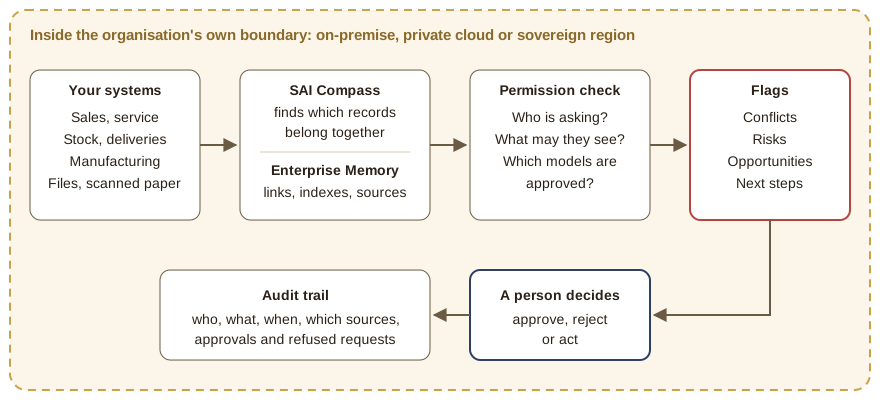
- It connects what you already have. Sales, service, stock, deliveries, manufacturing, accounts, files and scanned paper are connected as approved sources. SAI Compass, SenangAI's auto-discovery, works out which records refer to the same customer, product or order, without anyone mapping every link by hand. Those links, indexes and sources live in an Enterprise Memory that stays put even when you change AI models.
- It checks permissions first. Before anything is looked up, SenangAI checks who is asking and what they're allowed to see. If you can't open a record, the AI can't use it to answer you either. Work happens in three scopes, Personal, Teamspace and Organisation, each with its own permissions.
- It flags what doesn't add up. Conflicts between records, risks like a promise the stock can't cover, and opportunities worth acting on. Each flag comes with a caveat explaining why, and the sources side by side.
- It traces the root cause. For each mismatch, SenangAI shows which system or entry the wrong version came from. A user can flag a record, select the correct version, and track the fix until it's closed, so the same mistake doesn't keep coming back.
- A person decides. SenangAI suggests the next step. Anything critical, like merging customer records or changing a promise to a customer, waits for a named person to approve.
- Everything is recorded, for people and AI agents alike. Who asked, what they saw, which sources were used, which model answered, who approved what, and any request that was refused. AI agents get their own accounts and are treated exactly like human users: every action an agent takes is traced, audited and held to the same permissions.
Build your own, without code
SenangAI isn't only a system that fixes records. It's also a place to build on them. Its no-code tools let anyone create their own dashboards and apps on top of the connected records, with deep customisation:
- Personal: a salesperson builds a view of their own customers, open orders and overdue payments.
- Team: a warehouse team shares a dashboard of stock, incoming deliveries and items near expiry.
- Organisation: leadership gets one picture across sales, service and stock.
Most can be built and shared within minutes, not as an IT project. Every dashboard and app follows the same rules as everything else: people only see the records they're allowed to see, data stays inside the organisation's boundary, and every action is recorded. This is also what keeps SenangAI a product rather than a consultancy: once the sources are connected, each organisation builds what it needs itself.
SenangAI in practice
We've already put SenangAI to work in a partner's business, across sales records, service reports, manufacturing, vendor deliveries and returns, stock, and requests from the sales team. Each system kept its own version of the same customers, products and orders. Here's what changed:
- Stock and delivery mismatches were caught early, instead of surfacing weeks later.
- No more overcommitted sales. A sales request asking for more than stock and incoming deliveries could cover was flagged before anyone promised it.
- Nothing slipped through the cracks. Goods near their expiry date, deliveries made but not yet paid for, and loan items customers hadn't returned were all flagged for follow-up, not found at the year-end stock count.
- The source of mistakes was fixed, not just the mistakes, because each mismatch was traced back to where it started.
- New opportunities appeared. Understanding products and sales trends, SenangAI suggested product pairings for sales combos to lift demand and profit.
In every case, SenangAI suggested the next step and a person decided.
A worked example: one customer, six records
Here is the pattern step by step. Every name, number and address below is made up, but this is exactly the kind of mismatch businesses live with.
| # | Source | Customer name | Company number | Address |
|---|---|---|---|---|
| 1 | Sales system | Seri Maju Elektrik Sdn Bhd | 202001012345 | 12, Jalan Sebelah |
| 2 | Service system | Seri Maju Elektrik Sdn. Bhd. | 2020-0101-2345 | 12, Jln Sebelah |
| 3 | Scanned paper invoice | Seri Maju Elec. | 1234567-A (old format) | 12 Jln. Sebelah |
| 4 | Delivery records | SM Elektrik | 202001012345 | Lot 12, Jalan Sebelah |
| 5 | Accounts system | Seri Maju Elektrik | 1234567-A (old format) | not recorded |
| 6 | Sales system | Seri Maju Engineering Sdn Bhd | 201901054321 | 40, Jalan Sebelah |
1. The flag. A sales coordinator opens record 2. SenangAI checks her permissions, then shows a caveat:
Possible same customer: 4 other records. Records 1 and 4 share the company number, written differently. Records 3 and 5 use the old-format number, with a similar name and address. Record 6 has a similar name and street but a different company number: probably a different customer. Please review before relying on this record.
2. The decision. Merging customer records affects invoices, credit limits and deliveries, so it's a critical decision that waits for her. She confirms records 1, 2 and 4, checks an invoice showing both the old and new company numbers to confirm 3 and 5, and rejects record 6, a different company on the same street. The system is good at spotting likely matches. A person is good at spotting the neighbour with a similar name.
3. The root cause. SenangAI shows why the versions differed: record 2 was typed by hand with dashes in the service system, and records 3 and 5 came from paper invoices printed before the company's registration number changed format. She selects record 1 as the correct version and flags the service system's manual entry. The fix is tracked until it's closed, and any new record with the same mistake is flagged straight away.
4. The refusal. Later, a temporary staff member without access tries to look up this customer's credit limit. SenangAI refuses.
5. The record.
| Time | Who | Action | Result |
|---|---|---|---|
| 09:12 | Sales coordinator | Opened record 2 | Caveat shown: 5 possible matches |
| 09:15 | Sales coordinator | Consolidated records 1, 2, 4 | Approved |
| 09:31 | Sales coordinator | Consolidated records 3, 5 | Approved, old number confirmed on invoice |
| 09:32 | Sales coordinator | Rejected match with record 6 | Rejected: different customer |
| 09:40 | Sales coordinator | Selected record 1 as correct; flagged service-system entry | Root cause logged; fix tracked |
| 14:05 | Temporary staff | Searched customer credit limit | Refused: no permission |
If a merge ever turns out to be wrong, the trail shows who made it, when and from which sources, so it can be traced and corrected.
Your data, your models, your boundary
Sovereignty here is practical, not a slogan:
- Where it runs: on-premise, in a private cloud, in a sovereign region, or as a managed service.
- Where the data stays: files, indexes and logs stay inside that boundary, and don't have to leave the country.
- Which AI it uses: local, open-weight, regional or commercial models, or a mix, chosen by the organisation's own policy. SenangAI routes each request by "policy before performance": the data boundary and approved models first, then task fit, reliability, speed and cost. If a better model comes along, you switch the model, not the system.
If you're setting your own rules for AI, my AI governance starter guide is a good companion to this.
How it compares
There are other ways to deal with scattered records. Each has a place:
| Approach | Good at | Where it struggles |
|---|---|---|
| Spreadsheets and manual checking | Cheap, flexible, no new software | Slow, error-prone, and depends on a few people who know where to look |
| Traditional master data management (MDM) projects | Building one clean "golden record" across the company | Often long and costly to set up, and usually needs the data cleaned before it helps |
| General AI assistants | Quick answers and drafting | Often can't respect who is allowed to see what, keep a full audit trail, or stay inside your own infrastructure |
| SenangAI | Flagging mismatches and risks across existing systems, tracing root causes, with people approving and everything recorded, inside your boundary | It's still young: proven with one partner so far, and every new organisation starts with a proof of concept rather than a promise |
None of these is wrong. SenangAI is for the organisation that wants the speed of AI without giving up control, and wants to start with the data it already has, as it is.
Who it helps
SenangAI is built for businesses with stock, deliveries and many systems, government agencies and government-linked companies, and regulated enterprises like banks and insurers.
Inside any of them, a decision like this involves several people. B2B research often puts a typical buying group at six to ten people. Each gets something different:
| Who | What they worry about | What SenangAI gives them |
|---|---|---|
| Leadership | Overcommitted sales, unpaid deliveries, expired stock | Problems flagged before they cost money, and new opportunities |
| The person who feels the pain (operations, sales ops) | Hours of manual cross-checking, the same mistakes recurring | Connections found automatically, root causes traced |
| IT | Fit, security, lock-in | Runs on their own infrastructure, connects to what they have, any approved model |
| Risk and compliance | Who saw what, and who approved it | Permissions first, human approval, a full audit trail |
| Front-line staff (sales, warehouse, service) | Deciding with half the picture | A clear warning, the sources side by side, a suggested next step |
What's live today, and how to start
| Status | |
|---|---|
| SAI Compass, conflict and risk flags, root cause tracing, suggested next steps, human approval, audit trail | Live, in use at a partner business |
| Mismatches caught, no overcommitted sales, expiry, unpaid-delivery and loan-item flags, combo suggestions | Proven at that partner |
Every engagement starts with a 14-day proof of concept on the organisation's own data:
- Day 1: the first answer, with its sources, from one approved source.
- Day 5: a boundary test, where an out-of-scope request is refused.
- Day 14: one live workflow with human approval and a full record.
Then one department, then the next. It's the same pilot-first approach I recommend in my enterprise AI roadmap.
Quick answers
What is SenangAI?
Kognosys's sovereign enterprise AI platform. It connects an organisation's scattered records, flags conflicts and risks, traces their root cause and suggests next steps, with people approving critical decisions and everything recorded.
Does SenangAI change records on its own?
No. It flags and suggests. Anything critical, such as merging customer records, waits for a named person to approve, and the decision is recorded.
Are AI agents audited too?
Yes. In SenangAI, AI agents have their own accounts and are treated like human users: their actions follow the same permissions and appear in the same audit trail.
Is SenangAI tied to one AI model or one cloud?
No. It runs on-premise, in a private cloud, in a sovereign region or as a managed service, and works with the models the organisation approves.